

Forward Deployed Marketers: The Fix for the Enterprise GTM Execution Crisis
 By Ankur Saigal
Table of Contents
ToggleExecutive Summary
Enterprise revenue leaders usually take one of two paths to scale GTM: buy off-the-shelf software or attempt to build custom AI agent stacks internally. Buying fragmented martech tools creates execution silos, while attempting to build custom AI agent stacks in-house plunges teams directly into the “AI Plumbing Trap.” This becomes a persistent sinkhole of API maintenance, prompt drift, and engineering debt.
Inspired by Palantir’s Forward Deployed Engineer (FDE) framework, progressive revenue organizations are pivoting to Forward Deployed Marketers (FDMs): embedded execution strategists who bridge the gap between AI infrastructure and account-based revenue. Here is why both software-buying and internal-building strategies fall short, and how embedded FDM pods solve the enterprise GTM execution crisis.
The Enterprise GTM Execution Crisis: Why Revenue Leaders Are Pivoting to Forward Deployed Marketers
Chief Marketing Officers are facing an unprecedented operational paradox: despite record investments in MarTech stacks and AI capabilities, capital efficiency is plummeting.
According to research from Gartner, enterprise marketers actively utilize only 49% of their technology stack’s capability. The remaining half sits as expensive shelfware – a collection of disconnected tools, redundant subscriptions, and under-utilized software licenses sitting on your P&L.
Stack duplication is the main culprit. Revenue teams often buy distinct tools for intent data, lead enrichment, and AI messaging, creating massive feature overlap. This redundant spend inflates your P&L while leaving core platform capabilities untouched.
When generative AI entered the enterprise mainstream, growth leaders hoped it would immediately solve this operational strain. While it delivered localized productivity wins, it also accelerated fragmentation. Revenue teams attempted to assemble DIY AI stacks -stringing together horizontal LLMs, automated scraper scripts, webhook bridges, and custom prompt libraries.
The result? CMOs and RevOps leaders have been dragged into the “AI Plumbing Trap.” Instead of leading high-level GTM strategy and driving market position, marketing executives spend their weeks debugging fragile API connections, battling prompt drift, and reconciling conflicting account data across point solutions.
McKinsey’s research shows why the gains don’t add up: “These tools are widely seen as levers to enhance individual productivity… But these improvements, while real, tend to be spread thinly across employees.” The missing piece is a governed layer of domain and customer context that connects AI to core GTM workflows, which is what a central marketing brain provides.
— The state of AI, McKinsey (August 2026)
The Executive Litmus Test: Is Your GTM Engine Quietly Leaking Capital?
Before evaluating new software licenses or headcount additions, CEOs and CMOs must ask three uncomfortable diagnostic questions about their current revenue operations:
- The Strategic Mindshare Tax: Is your marketing leadership spending more time in operational syncs troubleshooting data integrations and Zapier webhooks than refining brand positioning, narrative framing, and sales enablement?
- The “MQL Disconnect” (High-Volume, Low-Context Leads): Are your sales reps ignoring AI-generated leads because automated tools produce high volumes of superficial alerts without account-level context, forcing reps to spend 20 minutes doing manual research before every call?
- The Hidden Engineering Payroll: How much of your high-earning marketing talent’s payroll is effectively paying for amateur software engineering, configuring custom scripts and prompt workarounds instead of driving pipeline?
If your revenue strategy is stalled on presentation slides while your internal team burns hours maintaining fragile automation scripts, the problem isn’t your strategy, it is your execution architecture.
The Lessons of Palantir: Why Enterprise GTM Requires Embedded Execution
To understand how to bridge the GTM execution gap, it helps to examine how the world’s most complex technology companies solved enterprise data adoption.
When Palantir Technologies scaled its platform across government defense and Fortune 500 enterprises, they recognized a fundamental reality: handing a client a sophisticated software license never guarantees business outcomes. Complex enterprise environments suffer from messy data, legacy workflows, and severe internal bandwidth constraints.
Palantir’s solution was the Forward Deployed Engineer (FDE),elite software builders embedded directly inside client operations to construct live data models, wire integrations, and deliver mission-critical outcomes inside the customer’s actual environment.
As enterprise GTM infrastructure grows as technical and data-intensive as core IT operations, B2B revenue teams require the exact same model: the Forward Deployed Marketer (FDM).
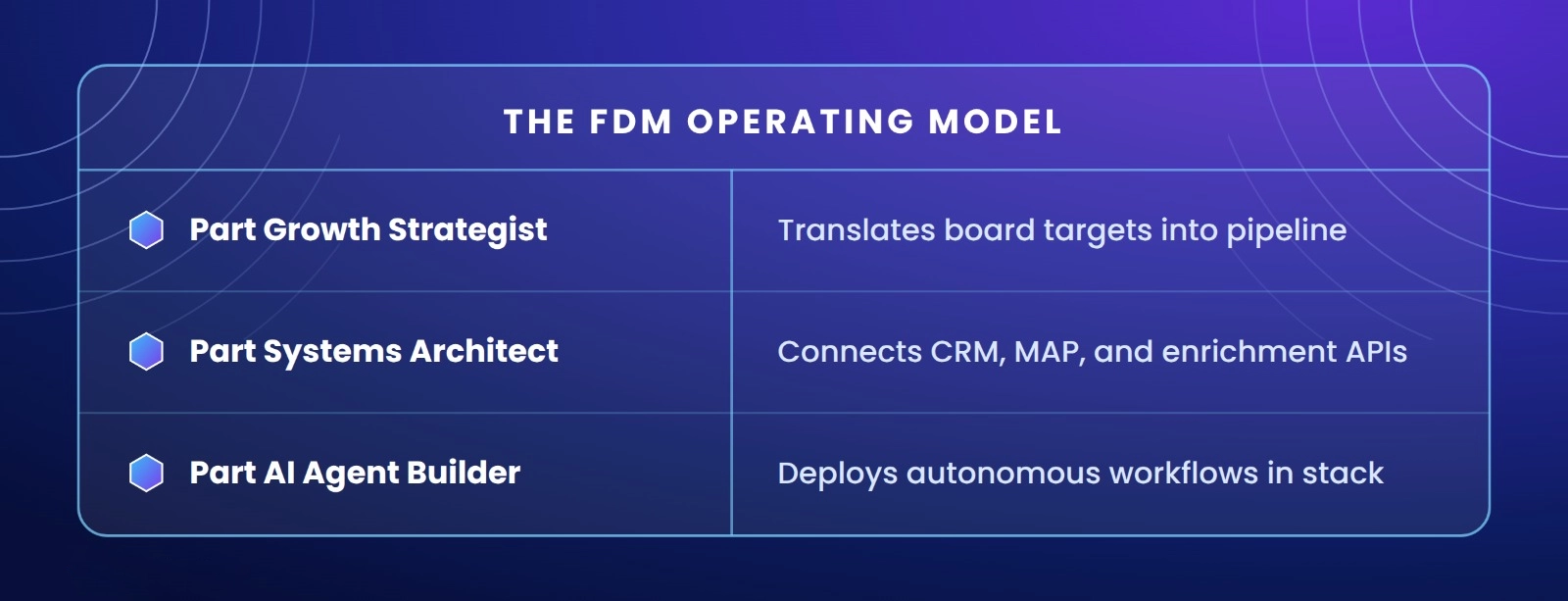
An FDM is a hybrid operator who unifies GTM strategy with technical execution:
- Growth & Brand Strategist: Owns the high-level revenue playbook, conducting brand strength, category, and competitor analysis; defining market ICP and the ‘right to win’; mapping buyer journeys; and designing integrated campaigns, media plans, and messaging frameworks.
- RevOps & Systems Architect (Hybrid AI Builder): Owns the operational engine, mapping GTM motions, establishing SDR sequences and sales handoff protocols, connecting MarTech data flows (CRM, MAP, intent APIs), and deploying autonomous AI agents directly inside your live stack.
The In-House Hiring Illusion: Why Sourcing FDMs Yourself Fails
When CEOs and board members recognize the power of the FDM methodology, the instinct is often to open an in-house hiring requisition. However, attempting to recruit and retain internal FDMs exposes organizations to four critical structural failure modes:
- The Unicorn Scarcity: Finding professionals who pair deep GTM strategy domain expertise with full-stack agentic engineering capability is statistically rare.
- Unviable Fixed Costs: Because these hybrid talent profiles command compensation packages on par with senior software engineers, hiring them in-house permanently inflates fixed GTM overhead.
- The Mid-Market Sprint Mismatch: Most mid-market and enterprise organizations do not need intensive systems engineering 365 days a year (learn [how lean teams scale pipeline]). They require intense, specialized sprints to build automated plumbing, followed by steady-state operational execution.
- Retention and Upskilling Risk: The moment an internal marketer masters advanced API orchestration, AI governance, and system architecture, enterprise tech firms actively recruit them away.
The Architectural Shift: Managed Agentic ABM + Embedded FDM Pods
This execution bottleneck is why modern revenue organizations are turning to a new category of execution: managed AI-native ABM.
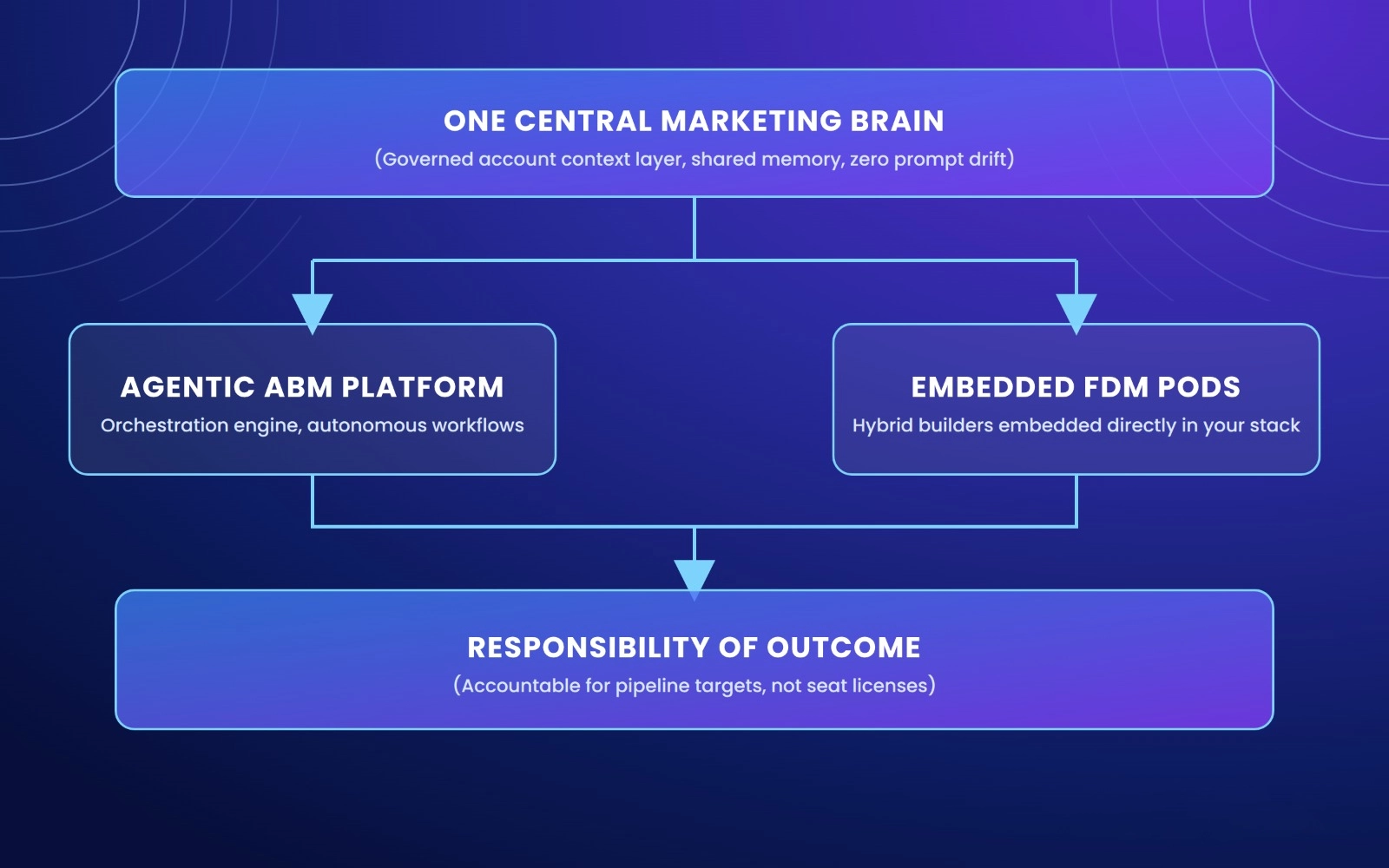
Instead of handing you another software license to manage or billing for static agency advisory hours, BambooBox pairs an Agentic ABM Platform with Embedded FDM Pods who drop directly into your existing MarTech stack, map broken processes, build automated GTM plumbing, and run your revenue engine end-to-end.
The overarching promise to revenue leaders is simple: Let’s You Lead GTM, Not Manage It.
Evaluating GTM Execution Models
When evaluating how to structure your revenue engine, compare how traditional delivery models measure up against managed AI-native execution:
Strategic Dimension | Legacy ABM Software | Traditional Agency Model | DIY AI Stack (Claude + Clay + Zapier) | AI-Native together |
|---|---|---|---|---|
Primary Deliverable | Software License | Billable Hours / Retainer | Custom Scripts & Prompts | Agentic Platform + Embedded FDMs |
Central Context Layer | Built/maintained by you | None (Manual outputs) | Disconnected point tools | Governed “Central Marketing Brain” |
Execution Ownership | Internal team | External agency staff | Internal team (acting as devs) | Embedded Forward Deployed Marketers |
Accountability | None (Sells seats) | Billed hours, not results | None | Pipeline Outcome Responsibility |
Time to Live Pipeline | 6 to 12 Weeks | Slow / Variable | Unpredictable / Stalls | 4 to 6 Weeks |
Stack Impact | Adds another license | Unequipped for AI tech | Adds technical debt | Orchestrates inside your stack |
Stop Managing Plumbing. Start Leading Strategy.
In modern enterprise GTM, having an impressive strategy deck is no longer a differentiator. The ultimate strategic advantage is execution velocity without operational friction.
If your growth pipeline is trapped behind fragile scripts, unintegrated software licenses, or overworked internal teams, it is time to evolve your approach.
Transform your GTM execution with embedded Forward Deployed Marketers.
Schedule an Executive Review with BambooBox →


