

ABM Stack Not Generating Pipeline? Run the Tuesday Test
 By Varun Rathish
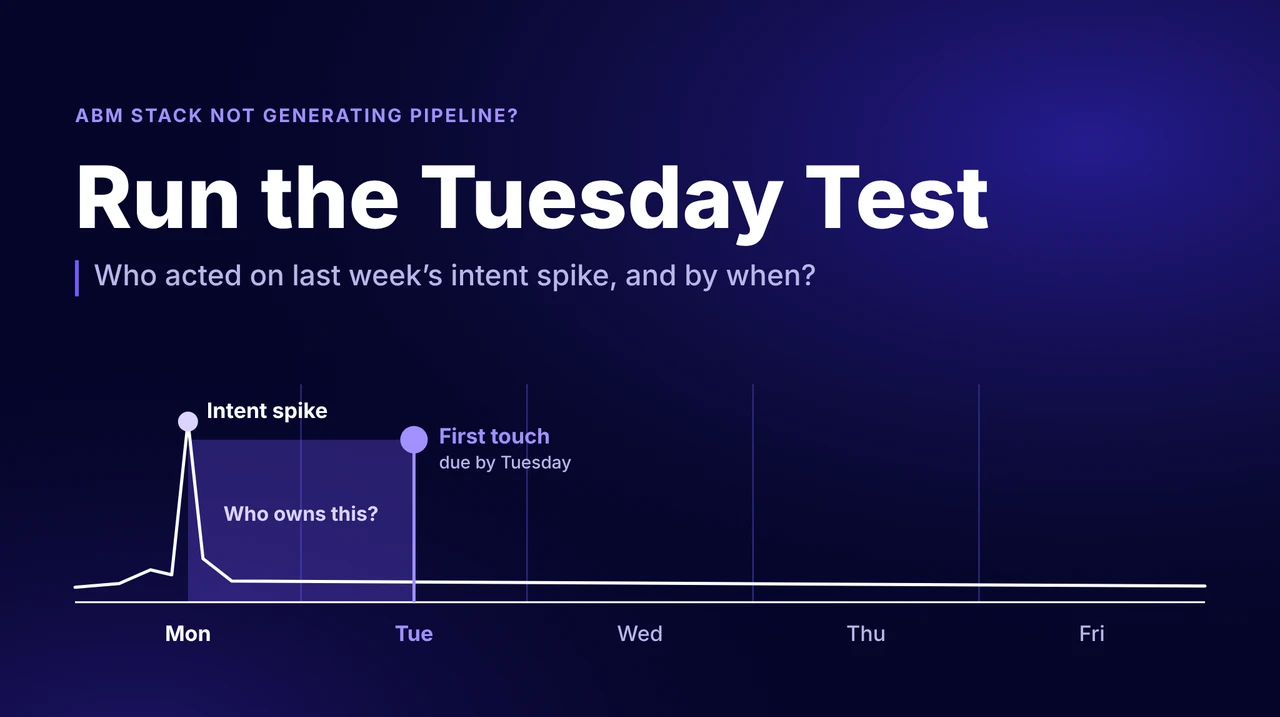
TL;DR: In our experience, ABM software that isn’t producing pipeline stalls at the response, not the detection: signals arrive, but nobody owns the same-day action. The Tuesday Test shows where it breaks. Then compare three ways to fix it: keep running the software yourself, add a traditional agency for support, or hand the program to an AI-native ABM agency such as BambooBox, which runs its own agentic platform inside your MarTech stack and takes responsibility for your pipeline outcomes.
Many marketing leaders now run an ABM stack not generating pipeline at the rate the business case promised. The licenses are paid for and the dashboards light up, yet the quarter still ends with a gap between the accounts the tools flagged and the opportunities sales actually works. Then the CRO asks what the stack is really producing, and the answer needs more than a dashboard.
Picture a Monday pipeline review. The platform shows forty accounts surging on intent. The CRM shows two new opportunities, and nobody can say who was supposed to act on the other thirty-eight, or by when.
That silence is the real diagnosis. In our experience, ABM software has an operating problem before it has a tooling problem, and this post shows how to check, then what to try next.
Table of Contents
ToggleWhy is my ABM stack not generating pipeline?
An ABM stack typically underdelivers pipeline when detection outpaces response: the software identifies in-market accounts, but no one owns the same-day action that turns a signal into a conversation. Common contributors are tool-first buying, thin data foundations, generic messaging and measuring activity instead of pipeline.
These causes are well documented, and we’ve covered why ABM programs fail before. Most of them show up after the software is installed.
Detection is a purchase. Response is a job: someone has to choose the play, develop the content and deploy it, every day. In our experience, budgets cover the first and rarely name an owner for the second.
ABM itself is not the problem. According to Demand Gen Report’s 2026 ABM Benchmark Survey (May 2026), nearly 80% of surveyed organizations run an ABM strategy, 52% say it is meeting expectations and a further 33% say it is exceeding them. The report does not state its sample size, so read it as direction. It also says teams are still working through challenges in scale, measurement, alignment and execution.
The Tuesday Test: what happened to last week's intent spike?
Signal-to-action latency is the time between an account showing buying behavior and the first relevant, personalized touch from your team. It is a number I rarely see on an ABM dashboard, and it is the one I would check first.
Pick one account that crossed your intent threshold last week and trace it:
- Who saw the signal, and where?
- Who decided what to do about it?
- Which channel carried the response, and what did the account receive?
- Did the account’s sales owner know before the touch went out?
- Did all of that happen by Tuesday?
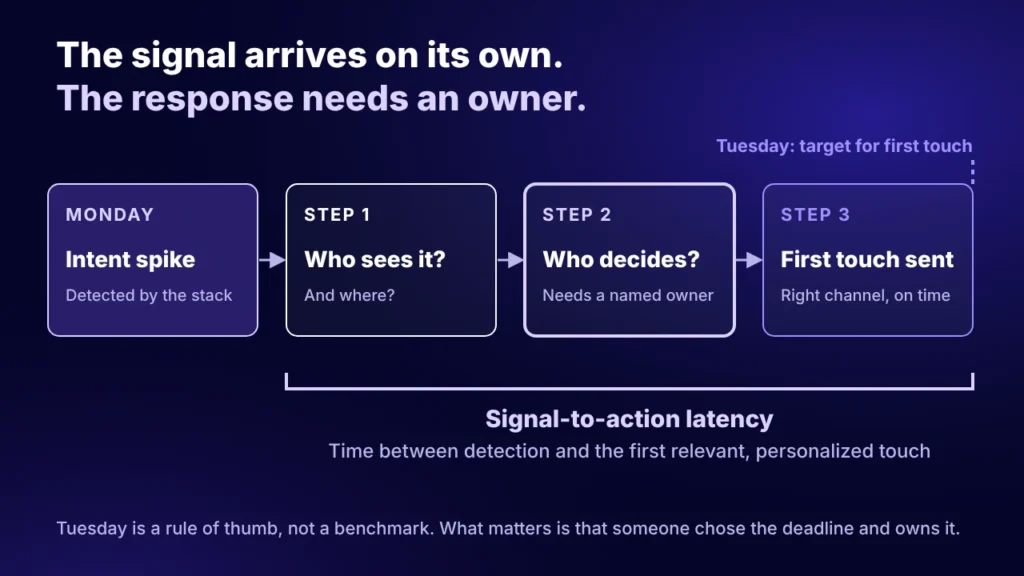
Tuesday is a rule of thumb, not a benchmark. What matters is that someone chose the deadline and owns it. A stack with no owner for step 2 is a smoke detector in a building with no fire brigade: it works perfectly, and it is an expensive way to watch a fire.
If you cannot name the owner of step 2, you already have your answer. Good looks like a named owner, a playbook chosen in advance and a first touch out the same day.
Is it the tools, the data or the operating model?
A stalled ABM stack is an operating-model problem when accounts are identified correctly but not acted on, a data problem when the wrong accounts or contacts surface, and a tooling problem when the software cannot do what the program needs. Five questions help separate the three.
# | Question | A “no” points to | First fix |
|---|---|---|---|
1 | Does every account that crosses your intent threshold get a named owner within a day? | Operating model | Name an owner and a 24-hour response rule |
2 | Are the flagged accounts inside your ICP, with a buying committee you can actually reach? | Data | Tighten the ICP and refresh contact data |
3 | Can the platform trigger the response you need (email, LinkedIn, ads) without a manual export? | Tooling | Fix the trigger or integration before adding tools |
4 | Do you report pipeline from engaged accounts, not just opens and clicks? | Operating model | Report pipeline sourced from engaged accounts |
5 | Could your team run next quarter’s program without a new hire or a developer fixing integrations? | Operating model (capacity) | Name who owns weekly operation before you renew |
If your “no” answers cluster in rows 1, 4 and 5, then in our experience replacing the software is unlikely to fix the result, because the new platform arrives with the same owner gap.
Should I replace my ABM platform, or change how it is run?
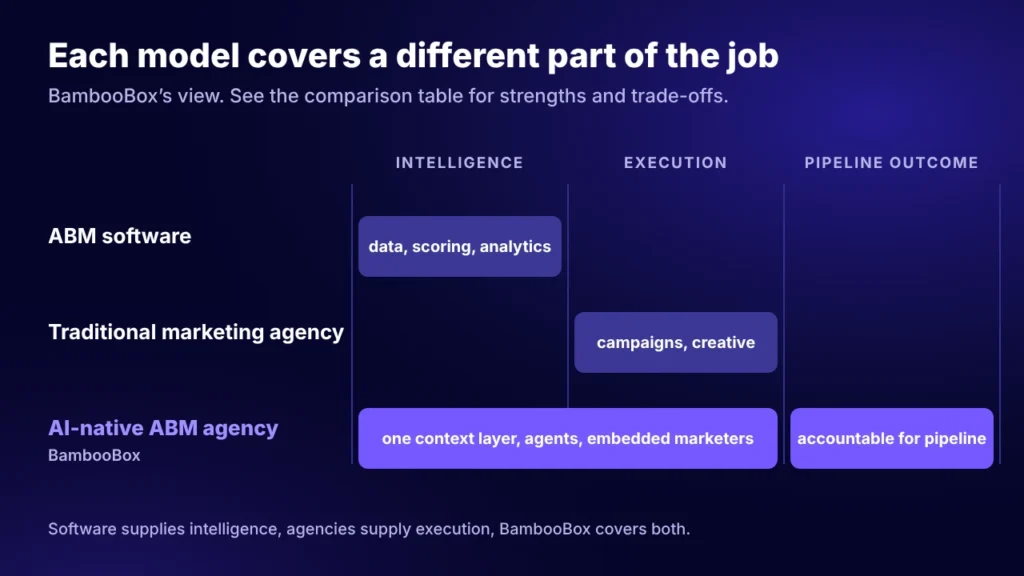
Replacing an ABM platform makes sense when it lacks a capability the program needs, such as a response channel or data coverage. Changing how it is run makes sense when signals already arrive but nobody owns the response. Three models are on the table: running ABM software yourself, adding a traditional marketing agency, or an AI-native ABM agency.
Our shorthand is that platforms stop at intelligence and agencies stop at execution. Each is good at something real, so here is a fair side-by-side.
| Model | What it does well | Watch for | Best fit |
|---|---|---|---|
| ABM software (for example 6sense, Demandbase) | Data coverage, scoring and analytics at scale | You still design, staff and run the program | Large teams with ABM operators in place |
| Traditional marketing agency | Execution capacity, creative and channel craft | Billed on hours or retainers; context often sits in decks and heads, not a shared system | Teams that need hands for a defined scope |
| AI-native ABM agency (BambooBox) | Its own agentic platform, run for you by embedded marketers inside your MarTech stack, accountable for pipeline | Results vary by account base and years of engagement | B2B teams that want to lead GTM, not manage it |
Buyers are moving the same way. G2’s July 2026 research found that software buyers’ preference for outcome-based pricing rose from 11% to 23% since 2025, and that finance involvement in software decisions rose from 31% to 46% in a year. Accountability for outcomes is moving into the buying criteria.
What is an AI-native ABM agency, and how does it work?
An AI-native ABM agency runs account-based marketing for a company through its own agentic platform, a shared customer context layer and embedded human marketers, and takes responsibility for pipeline outcomes. BambooBox, the AI-Native ABM agency, calls those embedded operators Forward Deployed Marketers.
BambooBox is built for the reader who recognized the Monday review above: a marketing leader who wants pipeline without becoming the operator of a stack. BambooBox has worked with 50+ B2B customers and was named a Customer Favorite in The Forrester Wave: Revenue Marketing Platforms for B2B, Q1 2026.
The model answers each failure point we just traced. BambooBox’s proprietary agentic platform is built around a customer context layer, a governed, customer-owned store of ICP, messaging, signals, segments, playbooks and measurement that every agent and channel reads from. Agents handle the repeatable work: Nova finds segments hiding in signals, Zippy fills buying-committee gaps only for accounts showing real intent, and Pulse optimizes toward pipeline instead of clicks.
A Forward Deployed Marketer (FDM) runs that platform inside your existing MarTech stack and steers strategy. Your team does not become the integration layer or the operator, and we take responsibility for lead-to-opportunity pipeline targets, not for licenses or hours.
The Tuesday Test is answered in advance. An always-on program builds preference with target accounts before they show a signal, and an opportunistic program fires when one appears: a renewal, a leadership change, a funding event or an intent surge triggers a playbook and a same-day LinkedIn, email and SDR response. Email, LinkedIn and Google Ads are live channels today, and in our experience a program is designed in days and live in roughly four to six weeks.
Say a contact at a target account visits your pricing page on Monday. The playbook has already been picked, and a LinkedIn touch, an email and an SDR task go out the same day.
On proof, the Darwinbox case study reports a 60% increase in lead-to-opportunity conversion from a program built on third-party intent, a 6D account scoring model and SDR outreach. Results vary by account base and year of engagement. BambooBox works with B2B teams across categories, especially lean marketing teams that want to lead GTM, not manage it.
How to evaluate your options before you switch
Before you renew, replace or rebuild anything, run the Tuesday Test on one real account and write down where the sequence breaks. Then put five questions to every option, including us:
- Who owns the response when a signal arrives?
- Who is accountable for pipeline outcomes?
- Where does customer context live, and who owns it?
- What does your team have to build and maintain?
- How long until it is live?
We would like to be tested on this. Book a conversation and bring the account you traced and your hardest questions. On Monday morning, pick one account that spiked last week and ask who did what by Tuesday.


