
Unboxing ABM
Unboxing ABM
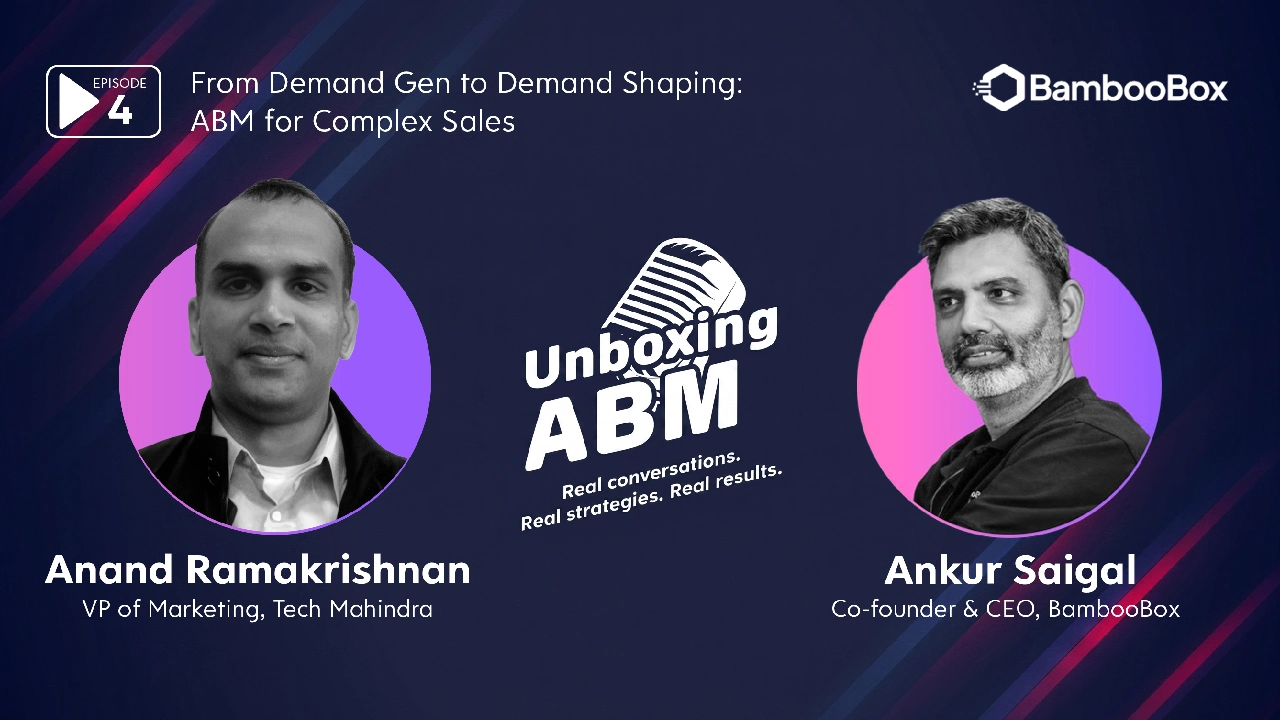
Episode: 4
In this episode of Unboxing ABM, Anand Ramakrishnan, VP of Marketing at Tech Mahindra, shares why ABM for enterprise companies is not about running targeted ads at intent signals, it’s about shaping demand across the entire buying journey.
We discussed why marketers in complex B2B sales must shift from demand generation to demand shaping, how the marketer’s role fundamentally transforms in a one-to-one ABM program, and why measuring ABM purely by pipeline is one of the most common reasons these programs never get off the ground.
Anand's ABM Principles:
When the conditions are right, ABM is your entire go-to-market: If your deal sizes are large, your sales cycles are long, and you have named accounts with active sales coverage, there's no reason to run any other kind of marketing alongside it. ABM gives you the biggest return, but only if it's treated as the central motion, not an add-on.
Demand shaping is not demand generation: In complex sales, marketing's job isn't to get someone to click an ad and fill out a form. It's to prepare the ground for conversion by building brand presence within target accounts, creating account-specific content across digital and in-person channels, and reducing friction for sales. The conversion happens, but marketing doesn't lead it alone.
In one-to-one ABM, the marketer must be the alter ego of the sales lead: They need to deeply understand the account, the competition, and the customer's unresolved problems, then translate that into a focused content and engagement strategy. Order-takers won't cut it. The right people, with real business empathy, are what make this motion work.
- 00:00 – Unboxing ABM: Snippet
- 02:18 – Anand’s marketing journey: From Infosys to Tech Mahindra across services and product companies
- 03:42 – The full-stack marketer: Why breadth across marketing functions matters
- 06:20 – Product vs. services marketing: The three non-negotiables (Product, Competition, Customer)
- 08:13 – Empathy as the #1 skill when hiring marketers
- 09:40 – What ABM means for large IT companies with complex sales cycles
- 15:48 – Demand shaping vs. demand generation: Why the distinction matters
- 19:55 – One-to-one vs. one-to-many ABM: How the marketer’s role changes
- 29:26 – ABM playbooks that actually works
- 34:30 – The hardest part of ABM: Creating content that solves customer problems
- 38:56 – Three challenges in ABM: Sales alignment, infrastructure, and skills
- 43:04 – Minimum martech stack required to get started with ABM
- 44:55 – Advice for marketers: Start small, prove success, then scale
Frequently Asked Questions
Demand shaping is the practice of preparing target accounts for conversion through brand presence, account-specific content, and multi-channel engagement — rather than trying to generate leads through forms and ad clicks. Unlike demand generation, the conversion in demand shaping is not led by marketing alone; it's a joint outcome with sales.
In one-to-many ABM, a single marketer can support around ten accounts by running targeted campaigns across a defined account list. In one-to-one ABM, a marketer typically handles two accounts at most — because they need to deeply understand each account's business, competition, and pain points, and build a custom strategy per account alongside the sales team.
Rather than measuring ABM purely by pipeline or lead volume, the recommended approach is to agree upfront on metrics across three areas: reputation (brand visibility within target accounts), relationships (depth of engagement across the buying group), and revenue influence (marketing's contribution to deal progression, not just sourced pipeline).
Two foundational platforms are recommended: a marketing automation system (for engagement tracking and attribution) and an intent data platform with programmatic advertising capability (for top-of-funnel one-to-many reach). Beyond these, additional tools can be layered in as the program matures.
Start with a small pilot — a limited number of accounts, existing technology, and sales allies who are willing to experiment. Keep content customization within what's realistically achievable. Don't wait for a perfect setup before launching. Show early results, use them to bring more people from sales and the rest of the organization on board, and then scale.