

The ABM Execution System: How Lean Teams are Winning the Enterprise Marketing Game
 Mar 23,2026
  By ajith@bamboobox.ai
Lean B2B marketing teams face immense pressure to scale, often falling into the trap of over-relying on fragmented MarTech stacks and generic AI generation. This creates mediocre “glorified demand gen” rather than true account-based marketing. To achieve enterprise-grade results, teams must adopt an AI-optimized ABM playbook. By leveraging AI for heavy lifting—like real-time data enrichment and campaign orchestration—alongside human expertise for strategic nuance, lean teams can drive real pipeline outcomes without bloating headcount. Read on to learn how lean teams are tackling this challenge.
Table of Contents
ToggleThe Expectation Evolution in B2B Marketing:
It’s no secret that most successful B2B marketing programs have been account based. And with the advent and current overdrive of the AI wave, lean marketing teams are expected to function like a 15 member team with a 5x output expectation. This puts marketing teams and their leaders in a very tricky situation leading to them spending time and money on evaluating and purchasing multiple tools and creating AI-driven playbooks to deliver outcomes.
But there’s one major question that still remains: Would you be able to achieve enterprise-grade scale and quality in your marketing efforts with a tool stack and AI-driven playbooks alone?
Where are the Gaps?
The problem here is two-fold.
- Over dependency on technology and tools: When lean teams are tasked with high outcome expectations, their first thought is that “we need more tools”.
- Falling into the AI trap: Using AI to scale their marketing efforts and focusing on quantity over quality.
These might not seem to be the biggest blockers around, but when you look at the larger picture, they can be detrimental to your entire marketing engine.
The MarTech Trap: Tools aren’t your only answer
Lean marketing teams often fall into the trap of believing that buying the right software will solve all their pipeline problems. But software doesn’t run itself.
For example, you might build complex data enrichment workflows in tools like Clay and purchase licenses to tools that give you buyer intent signals, only to realize you aren’t really making the most of that intelligence.
Unfortunately, raw data is essentially useless without the right experts working on making the best of it because translating intent signals into real-world outcomes requires deep focus, not just high volume. It takes specialists to properly segment these accounts, craft personalized messaging, and orchestrate seamless, yet nuanced campaigns.
Without the internal bandwidth to maintain the level of rigor required to run a full-fledged ABM program, teams inevitably default to “glorified demand gen” in the name of ABM – blasting generic, one-size-fits-all campaigns while only mimicking ABM in fragmented pieces.
This is like plugging leaky plumbing – allowing teams to show scattered wins and vanity metrics but the program completely misses the cohesive, end-to-end process required to convert high-value accounts.
The AI Trap: Massive volumes, average output
As generative AI becomes standard practice, it’s leading to B2B marketing averaging out. Teams of all sizes are leveraging AI to achieve their deliverables – churning out massive volumes of content, strategies, and experiments, but the results often end up being quite mediocre and generic.
For instance, an AI tool can write content for outreach that addresses the person’s pain points without marrying their solution with their point. With surface level differentiation and not targeting persona specific pain points – which is ultimately not helping anyone’s case.
Here’s an example below.
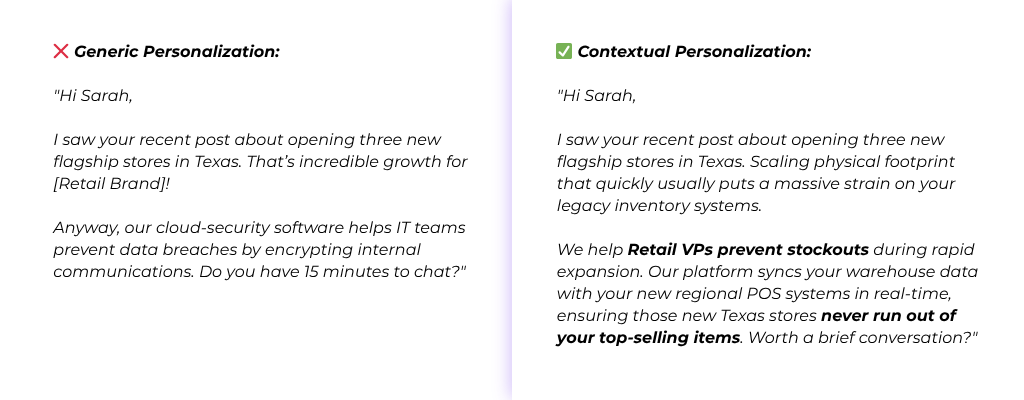
Scaling ABM isn’t just about using AI to show a lot of activity being done, it requires human oversight to elevate the content from merely acceptable to outcome-driven.
The Solution: Lean teams need an AI-optimized ABM playbook
The goal is to move from an AI-dependent playbook to a truly AI-optimized playbook.
So, how do you break free from these traps? The answer isn’t ditching AI or not using a tech stack. It’s changing the way you operate.
Don’t treat AI as a shortcut to bypass the bruntwork, lean teams need to use AI as an enabler within a unified system. We like to call this an ABM execution system – an end-to-end approach where AI does all the heavy lifting to ensure scalability and experts provide strategic direction and quality control.
Here’s what a truly optimized AI-ABM Playbook looks like
When you deploy things the right way, an AI-optimized ABM playbook can enable you to streamline your entire ABM operating system and ensure you make the most out of the least time and monetary investment possible. Here’s how it can enable you:
A) Continuous Account Intelligence (Beating Data Decay): Contact data decays at a rate of roughly 12% every quarter. Traditionally, it takes days or weeks to enrich data and once that’s done, campaigns are run on these contacts for quarters to end without any update because it’s a painstaking manual process to constantly keep check on these contacts.
- AI’s Role: AI agents can continuously track changes in the buying committee, validate contacts continuously and update these lists in real time.
- The human-in-loop: Strategists have real-time intelligence to clearly validate if your buyer group is in check and plan campaigns accordingly.
B) Integrated Campaign Strategy & Design: Tools will give you the intelligence you need on your target accounts – where they are in their buying journey and what they are looking for but they won’t tell you how to convert them.
- What this means: Once your tool stack helps identify active buying committees – experts now play a pivotal role in designing playbooks across segments and mapping out distribution channels. This is to ensure that every channel reinforces the other with messaging that aligns across the board.
C) Personalized & Segmented Messaging: This is going to be your differentiating factor. You can’t send the same generic message to your entire TAM and call it ABM.
- AI’s involvement: Helping lean teams scale the creation of different messaging variations, content production, creative design and more across different personas, industries and buying stages.
- The human touch: Using the right prompts to get the desired output is extremely crucial, otherwise AI tends to hallucinate. Once AI gives an output – an expert’s intervention is needed in reviewing, refining and adding a unique touch of your brand into AI-generated assets which might include emails, ads, landing pages and other long form pieces of content. This ensures that every unique ICP receives a highly relevant message.
D) Coordinating campaign execution across multiple channels: Strategy is important but you need to be able to execute this seamlessly.
- The game here: Using an AI-powered orchestration engine to help manage the daily operations of the campaign helps you trigger the right communication to the right audience at the right moment based on buying intent or account engagement.
E) Real-time optimization and reporting what matters: A crucial factor in successful campaigns is to constantly analyze what’s working and what’s not and pivot quickly. Measure > Reiterate > Deliver outcomes.
- The role of AI: Agents track performance daily across campaigns and highlight the best and worst performing campaigns.
- The human intervention: Reviewing these insights, making changes and optimizations to campaigns and translating raw data into actionable reports.
The Path Forward: Buy Outcomes, Not Just Software
Ultimately, achieving enterprise-grade quality with a lean team isn’t about more tools or more people. You simply cannot make the maximum ROI if you’re building an expensive, fragmented tech stack. It is a losing battle for a lean team without dedicated folks to operate, optimize, and manage these tools.
An alternative option that lean teams who have implemented successful ABM programs is to partner with AI-native execution partners who already bring the required enterprise-grade tech stack and the human expertise to run it.
By adopting this model, lean marketing teams can instantly punch above their weight by expanding their GTM motion, run rigorous ABM programs and deliver outcomes – all without increasing headcount or buying multiple tools. This means internal teams can become more strategic and experimental focussing on sales and marketing alignment and stakeholder engagement while their AI-native execution partners ensure that all the crucial aspects of their ABM motion is running smoothly, handling all the brunt work and ultimately delivering outcomes.


 Nov 12, 2025

