

The Death of the “12-Month ABM Rollout”: Why Speed is the New B2B Marketing Moat
 Apr 13,2026
  By ajith@bamboobox.ai
In the AI-driven era, speed is the ultimate competitive moat for B2B marketing. The traditional 12-month Account-Based Marketing (ABM) rollout is dead, as CEOs demand faster ROI. Instead of wasting quarters buying fragmented tools and building systems from scratch while target data decays, lean marketing teams are adopting pre-built, AI-enabled execution engines. This plug-and-play approach allows teams to launch campaigns in 45 days, fail fast, and scale faster.
Table of Contents
ToggleTime is Relative in this AI-Driven Era:
The world is evolving rapidly, faster than our operating models can keep up with. We all know that we’re now in an AI-driven era, with teams and organizations being forced to innovate at lightspeed across every single function.
Product cycles used to take years; now take months. Messaging that’s relevant today will be obsolete in 6 months. Delivery and CS teams are automating workflows in order to cut response times in half.
Speed is no longer a tactical advantage, it is imperative for survival.
Introducing the Era of Fast ABM
The biggest shift we’ve seen with the advent of AI has been in B2B marketing. For instance, take Account-Based Marketing (ABM), it was always considered a slow burn.
Marketing teams would confidently walk into meetings and say:
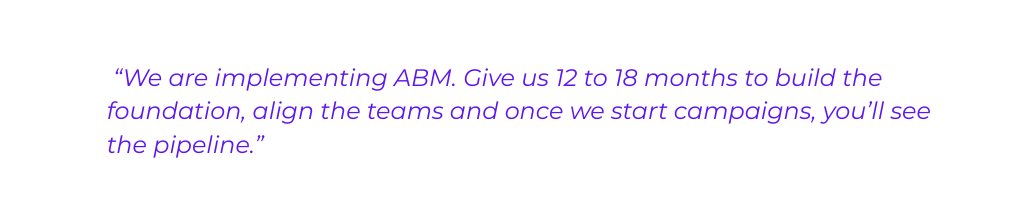
Today? The same statement will never fly.
CEOs and business leaders don’t have the luxury, patience, or runway to see if a marketing strategy actually works. When organizations are fighting to increase revenue and get ahead of the competition in capturing market share, a 12-month experiment is not the best way to go.
Time-to-value must be measured in weeks, not quarters. Leaders in 2026 demand that marketing teams drive enterprise pipelines with speed and agility at an early-stage stage.
The Biggest Challenge: A Pre-Conceived Notion of Traditional ABM
Traditional teams take 12 to 18 months to show time-to-value for their ABM motions, why is that?
That’s because building an ABM system from scratch is a logistical challenge that not many lean teams have cracked. There’s a steep learning curve, requiring alignment across teams, messaging, channels and finally execution discipline.
The Painful Reality of Building an ABM System In-House
Your first 3 months: You spend a quarter evaluating tools and purchasing expensive technologies with the hope that it will change everything.
Once you’ve onboarded these tools, you spend the next quarter integrating them into your systems and processes without breaking your existing processes.
But that’s not the end of it, because sometime in the next quarter you realise that the software that you’ve bought doesn’t run itself. You then start scrambling to hire teams to manage data, a copywriter, a designer and a performance marketer to execute these campaigns.
And finally, you launch your first “pilot” campaign after 40+ weeks of prep.
The irony here is that by the time you go live, your data has probably decayed by around 30% – buying committees have changed, people have shifted jobs, priorities have changed, product narratives could have potentially changed or your TAM went ahead with your competitors and you’ve just spent a year doing everything but actually marketing.
How Modern Marketing Teams are Tackling This: Fail Fast, Scale Faster
The key differentiating factor in becoming a competitive moat is to stop building the system and start driving it.
What if you didn’t have to build this system yourself? What if there was a pre-built, tried and tested, AI-enabled execution system? Instead of spending your first six months building a fragmented system and trying to stitch things together – you can simply plug your strategy into an existing framework.
This model brings out a complete shift to the traditional timelines. You can now go-live in 45 days – launch fast, fail fast, pivot fast, and focus on entirely optimizing the system from day 1 rather than building things from scratch.
So, What Does the Modern ABM System Look Like?
An AI-enabled execution engine replaces the fragmentation that comes out of siloed tools, disconnected teams, and agencies with a single, unified operating system. Here’s what this system looks like in practice:
- Continuous Account Intelligence: Datasets go stale in weeks and teams must be wary of this – native AI agents come in here to continuously ingest first and third party intelligence along with refreshed contact level data.
- Integrated Playbooks: Ensuring that you’re saying the same thing across channels along with conveying the right message to the right persona at the right time.
- Personalized Creative Inputs with the Human Touch: While using AI to generate content or design creative has become a standard practice, allowing teams to scale the creation of personalized messaging across personas and industries while a human in the loop is crucial to ensure quality control and nail the narrative.
- Multi-Channel Orchestration: An execution engine to seamlessly run campaigns across multiple platforms with a human oversight to ensure things run smoothly – acting as a direct extension of your in-house team.
- Clear Reporting: A unified reporting dashboard that gives you a 360 degree view of your campaigns, funnel movement, and opportunity tracking that ensure you don’t need to crunch data across multiple spreadsheets.
With the modern B2B marketing shift, the team with only the best tools doesn’t always come out on top. It’s all about striking when the iron’s hot and getting the right message to the right accounts when they’re in-market. Speed is your ultimate moat – it’s time to start executing.


 Mar 23, 2026

