

What Is Media Mix? Definition, Examples, and a B2B Framework for Getting It Right
 By admin
TL; DR: A media mix is the set of channels, and the budget behind each one, that a company uses to reach its audience: paid search, LinkedIn, email, events, and organic content. Generic media mix advice is built for consumer brands chasing reach, and it wastes budget the moment you’re selling to a multi-person buying committee instead of a single shopper. This guide breaks down what media mix actually means, gives real consumer and B2B examples, and shows a practical way to build your channel mix around your accounts instead of an industry average.

Ask ten B2B marketers to define their media mix, and most will hand you the same list: paid search, LinkedIn, email, maybe an event or two. That list isn’t wrong. It’s just incomplete. It treats a B2B sale, which runs through a buying committee over several months, the same way a consumer brand treats a single shopper deciding in the checkout line.
The problem is that most media mix advice was written for that shopper, not for the committee. B2B teams aren’t reaching a mass audience. They’re reaching a list of named accounts, and that one difference changes almost everything about how the mix should be built.
This guide covers:
- A straight definition of media mix, with consumer and B2B examples
- Why generic media mix models break down once a sale involves multiple stakeholders
- What 2026 spend data actually shows about channel allocation
- A practical way to split channels by account instead of by industry benchmark
Table of Contents
ToggleWhat Is Media Mix?
The term “media mix” refers to the communication channels a business uses to advertise specific goods or services. It’s a combination of channels, like paid search, social ads, email, events, and organic content, selected to reach the greatest possible audience. The terms “mixed media advertising” and “marketing media mix” describe the same idea.
People often confuse media mix with marketing mix. It’s an easy mix-up. Marketing mix refers to the classic four Ps: product, price, place, and promotion. Media mix is one piece of that fourth P. It’s specifically about which channels carry your message, and how your budget splits across them.
In practice, a media mix usually falls into three buckets:
- Paid media: channels you pay for directly, like paid search, LinkedIn ads, or intent-based display
- Owned media: channels you control outright, like your website, email list, and content library
- Earned media: organic search visibility, PR, and word of mouth you didn’t pay to generate
A simple consumer media mix example might split budget like this:
- 40% paid social
- 25% paid search
- 20% email, SMS
- 15% organic content
A consumer media mix often puts the largest share of budget behind paid social and paid search, since both are built for broad reach, with smaller, steadier amounts going to email and organic content to support retention and credibility.
A B2B example looks different, even when the channel names match. The goal isn’t reaching the most people. It’s reaching the right two hundred accounts, often enough that a buying committee notices.
Why Generic Media Mix Models Break Down in B2B
Most media mix guidance was written for companies selling to individual consumers, and it shows. Consumer media mix models optimize for reach: the more people who see an ad, the better. B2B doesn’t work that way.
A typical B2B deal involves six to ten stakeholders. Much of their research happens off search entirely, in what’s often called the dark funnel:
- Conversations in Slack
- Peer recommendations
- Analyst calls
- Vendor comparisons that never touch a trackable channel
Reach doesn’t help much if the people who actually matter aren’t in the audience you’re reaching.
Sales cycles make this worse. A consumer ad campaign might convert in days. A B2B enterprise deal can take six to eighteen months. A media mix built for short attention spans and quick clicks doesn’t match how buying committees actually decide.
Tracking gets messy too. A champion sees a LinkedIn ad. She forwards a case study by email. She mentions your brand in an internal Slack thread. Then, weeks later, someone finally fills out a form. Standard last-click reporting gives credit to none of that earlier work. That’s part of why a channel-first media mix, built off industry-wide benchmarks, usually falls short for B2B teams. It was never built around how B2B buying actually happens.
Media Mix Optimization: How Much to Spend Across Channels in 2026
Gartner’s 2026 CMO Spend Survey found that awareness and conversion now account for 62.6% of total media spend. That’s up 10% since 2024. Digital channels now make up more than two-thirds of total media investment. That’s a useful benchmark for B2B teams, but the right split still depends more on account tier than funnel stage alone.
Quick snapshot of the numbers:
- 62.6% of total media spend now goes to awareness and conversion combined
- +10% increase in that share since 2024
- 2/3+ of total media investment now goes to digital channels
That shift makes sense on paper. Marketing leaders are under more pressure than ever to prove pipeline impact. So budget naturally flows toward the stages closest to revenue. But funnel stage is a blunt tool for B2B. A single account can sit in “awareness” and “consideration” at the same time, because four different stakeholders are each at a different stage of their own research.
A better question than “how much goes to awareness versus conversion” is “how much goes to my best accounts versus everyone else.” Picture two companies with the exact same funnel-stage budget split. One weights spend by account potential. The other spreads it evenly. They can still get very different pipeline results. Benchmarks are a good starting point for sanity-checking your overall mix. They aren’t a target to hit exactly.
6 Ways to Optimize Your B2B Media Mix
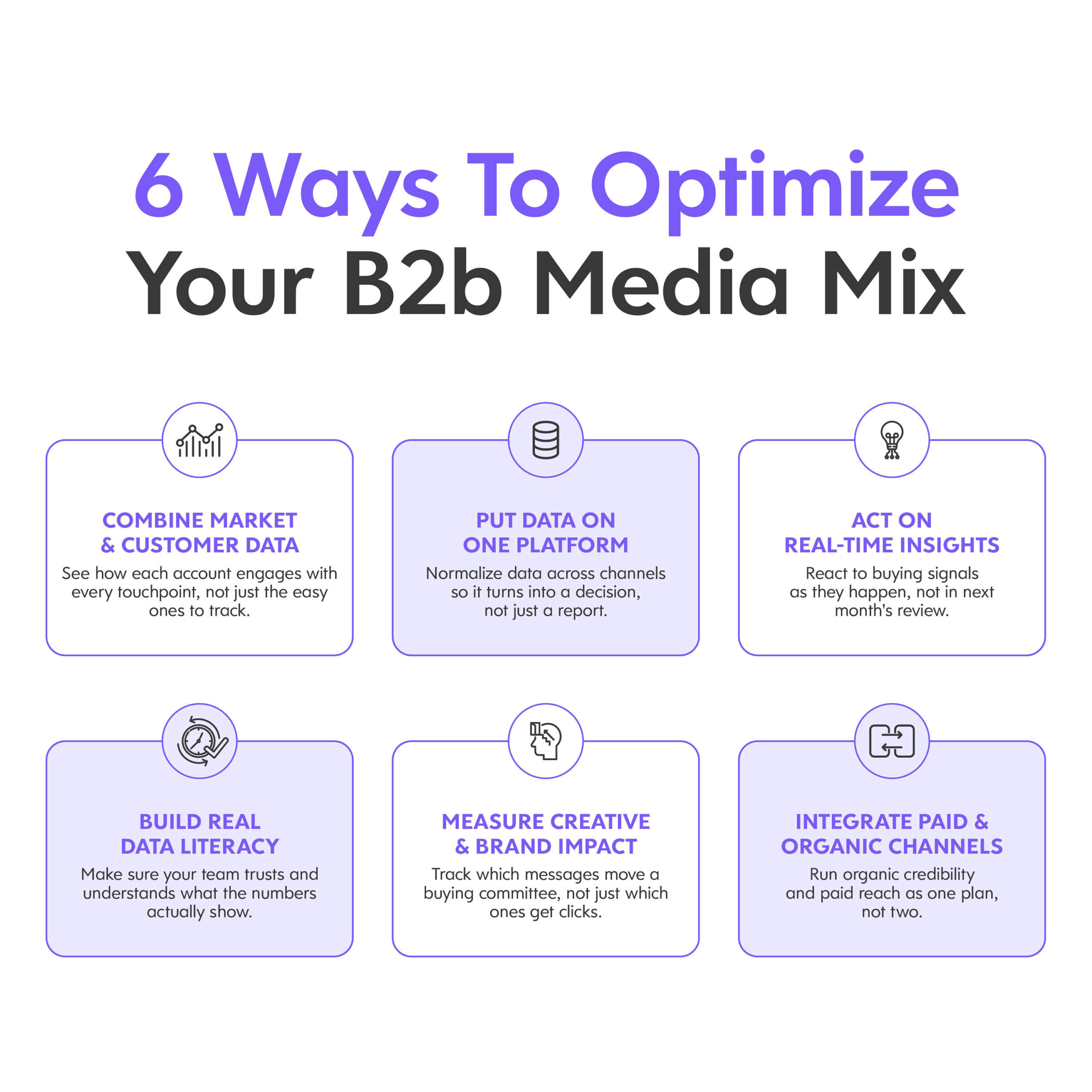
Knowing how much to spend across channels only gets you halfway there. The other half is running the mix well, day to day. Six practices consistently separate a media mix that performs from one that just exists:
- Combine market and customer data. Track how each account interacts with every touchpoint, not just the channels that are easy to measure. Offline touches, like events and direct mail, deserve the same scrutiny as a click on a paid ad.
- Put your data on one platform. Scattered spreadsheets and disconnected tools make it nearly impossible to see the full picture. A single platform that normalizes data across channels is what turns raw activity into a decision you can actually act on.
- Act on real-time insights, not last month’s report. A media mix that only gets reviewed in a monthly readout is already a month behind. The accounts worth reacting to fastest are the ones showing intent signals right now.
- Build real data literacy on your team. More dashboards don’t help if nobody trusts or understands what they show. Teams that misread their own data end up optimizing toward the wrong accounts.
- Measure creative and brand impact, not just clicks. Which messages and creative elements actually move a buying committee is a question most media mix reviews skip entirely, even though it often explains more of the result than the channel choice does.
- Integrate paid and organic channels instead of running them separately. Organic content builds the credibility a buying committee checks before a call. Paid and intent-triggered channels get you in front of the right accounts sooner. Run them as one plan, not two.
Building Your Media Mix Around Accounts, Not Channels
Most B2B teams build their media mix backwards. They pick channels first, based on what’s trending or what a competitor is doing. Then they hope those channels happen to reach the accounts that matter. Flip that order, and the mix gets sharper.
Start with your accounts, not your channels. In practice, that comes down to three steps:
- Tier your accounts. Not every account you could sell to deserves the same investment. A strategic tier, the accounts with the highest revenue potential and clearest fit, can justify a heavier, more expensive mix: paid social, direct mail, event invitations, and account-specific content. A nurture tier gets a lighter mix built mostly around owned and earned channels, since the payoff doesn’t yet justify heavier spend.
- Layer in buyer intent. Some accounts are actively researching a category and show up in intent signals well before they ever visit your site. Those accounts deserve a faster, heavier push than accounts sitting quietly in your CRM with no recent activity. This is where account intelligence earns its keep. It tells you which accounts to weight up this month, not just which accounts exist.
- Assign channel and cadence per tier, not company-wide. A strategic-tier account in an active buying window might see five touches across three channels in two weeks. A nurture-tier account might just get a monthly email, until its intent signals change.
This is easier to describe than to run by hand. Keeping tier assignments, intent monitoring, and channel execution in sync across hundreds of accounts is exactly the kind of work an AI-native ABM platform is built for. It works best paired with a team that adjusts the plan as accounts move between tiers. The alternative, tracking all of this in spreadsheets while also running campaigns, is how most in-house teams end up back at one generic media mix by the second quarter.
None of this works without a clear read on buyer intent signals in the first place. Tiering by revenue potential alone still treats every account in a tier the same way. Intent data is what lets you move one specific account up or down within its tier, in near real time.
Which Channels Actually Belong in a B2B Media Mix?
The core B2B media mix usually includes LinkedIn, email, intent-triggered display or paid social, webinars and events, organic content, and increasingly, direct mail for top-tier accounts. Which channels dominate the mix should follow account tier and intent strength, not a fixed industry template.
LinkedIn remains the anchor channel for most B2B teams. The Content Marketing Institute’s 2026 research found 76% of B2B marketers name LinkedIn their top channel for thought leadership. It’s usually the first place a buying committee checks out a vendor before a call. Email still does the heaviest lifting for personalization. The same research found 85% of B2B marketers personalize email content, compared to just 31% for paid ads. That gap is also where most media mixes leave the most value on the table.
Beyond LinkedIn and email, a strong B2B media mix usually includes:
- Intent-triggered display and paid social: ads that turn on specifically when an account shows buying signals, instead of always-on spend
- Webinars and events: for accounts further along in the buying process
- Organic content and SEO: for the broad, top-of-funnel searches your own prospects are already running
- Direct mail: for a small number of top-tier accounts, where a physical touch still stands out
Digital channels carry the bulk of most B2B media mix budgets now, but the best mixes still leave room for the offline touches a purely digital plan misses.
How Do You Optimize Your Media Mix Without More Headcount?
AI agents can run the repetitive parts of a tiered media mix: personalizing content, scoring accounts, and triggering campaigns as intent changes. They do this without needing a bigger team to match. Gartner’s 2026 CMO Spend Survey found CMOs now allocate 15.3% of marketing budget to AI on average, rising to 21.3% at organizations with mature AI programs. That tells you where budget is already headed.
For a five-person marketing team, running five to seven channels across three account tiers by hand just isn’t realistic. This is where AI agents that run execution change the math. Agents typically take on:
- Account scoring
- Content personalization
- Campaign triggering based on intent changes
That frees the humans on the team to focus on strategy, and on the accounts that need a judgment call.
When we ran this model with Algonomy, the result wasn’t just faster execution. It was 39% more opportunities generated through the BambooBox platform, without the team growing to match. That’s the practical case for pairing a platform with managed execution. It isn’t about replacing marketers. It’s about letting a lean marketing team run a media mix that would otherwise need three times the headcount.
Common B2B Media Mix Mistakes
A few patterns show up again and again in media mixes that don’t perform. Most of them trace back to treating B2B like B2C:
- Treating every account the same. A media mix built for your whole database, instead of weighted by tier and intent, spreads budget evenly across accounts that will never buy and accounts that are ready right now. The result looks busy and produces very little pipeline.
- Chasing channel diversity for its own sake. Adding a new channel just because a competitor is on it, without a clear reason tied to account fit, usually just adds cost and more reports to read. A tighter mix, run well, consistently beats a wider one run thin.
- Ignoring intent signals until a lead form gets filled out. By the time someone fills out a form, they have often already narrowed their shortlist. A media mix that only reacts to inbound forms is, by definition, always a step behind.
- Setting the mix once a year and never touching it again. Channels perform differently as accounts move through tiers, and a mix that made sense in January can be stale by the third quarter. This matters even more for teams running an enterprise ABM expansion into new markets or segments, where the right mix for an established core motion won’t automatically fit a brand-new one.
Getting Your Media Mix Right
Media mix isn’t a channel checklist. The generic version, built for reaching millions of consumers, was never going to work for a market defined by a few hundred named accounts. The B2B teams getting real pipeline out of their media mix start with accounts and intent. Then they layer in channels and cadence, not the other way around.
If you’re rebuilding your media mix for 2026, this account-first approach gives you a starting point:
- Tier your accounts
- Weight by intent
- Assign channels and cadence per tier instead of company-wide
Doing that by hand, across hundreds of accounts, is where most in-house teams run out of time.
That’s the gap BambooBox closes. One integrated model combines the platform, the AI agents, and the GTM strategists who run the mix day to day. Your team gets a media mix built around your actual accounts, not an industry average. Book a consultation to see what that looks like for your pipeline.
Frequently Asked Questions
1. What's the difference between media mix and marketing mix?
2. What are some examples of a media mix?
3. How much of a B2B marketing budget should go to paid vs. organic channels?
4. How often should a B2B media mix be reviewed?
5. Can AI actually improve media mix decisions, or is it hype?
6. What's the right media mix for a lean team vs. an enterprise ABM program?
7. What is media mix modeling, and how is it different from a media mix?


