

B2B Omnichannel Marketing Strategy: Why More Channels Alone Won’t Fix Your Pipeline
 By admin
TL;DR: A B2B omnichannel marketing strategy only works when every channel pulls from the same account data, not when you simply add more channels. This post breaks down what separates omnichannel from multichannel, why most B2B demand generation programs stall out even with a full channel mix, and a 5-step framework for fixing it. You’ll also see what changes when AI-native ABM execution replaces disconnected tools and teams.
Most B2B marketing teams didn’t lose their pipeline problem to a lack of channels. They lost it to channels that don’t talk to each other. Buyers now research on their own terms: they consult an average of seven information sources before a purchase decision, moving between LinkedIn, email, review sites, webinars, and a vendor’s own website, often in the same week.
That’s the real challenge behind any demand generation and omnichannel marketing strategy today. It’s not “which channels should we add.” It’s “how do we make the channels we already run act like one coordinated experience instead of five separate campaigns.” This post explains what changes when you get that right, and what’s usually breaking when you don’t.
What Is B2B Omnichannel Marketing, and Why Does It Matter Right Now?
B2B omnichannel marketing is an approach where every channel, email, paid social, events, sales outreach, and your website, draws from the same account and buyer data so a prospect gets a consistent, connected experience no matter where they show up. It’s not about being everywhere. It’s about every channel knowing what happened on every other channel.
This matters more now because buyers have quietly taken control of the process. Gartner’s own research shows buyers spend roughly 80% of their journey working independently, researching, comparing, and forming opinions before a sales rep ever gets involved. Meanwhile 61% of B2B buyers say they’d prefer a rep-free buying experience entirely, and 73% actively avoid vendors who send irrelevant outreach. If your channels aren’t sharing what they know about an account, you’re the vendor sending irrelevant outreach, even with the best intentions.
The practical result: a buyer who downloaded your report last week gets a generic cold email this week, because your email platform has no idea the report download happened. That’s a channel problem disguised as a messaging problem.
Omnichannel vs. Multichannel Marketing: What’s Actually Different?
Multichannel marketing runs several channels independently, each with its own goals and message. Omnichannel marketing connects those same channels through shared account data, so a buyer’s activity on one channel shapes what they see next on another. The difference isn’t how many channels you use. It’s whether they’re talking to each other.
Most B2B teams already run multichannel marketing. They have email, ads, events, and outbound running at the same time. What they’re usually missing is the connective layer that turns those separate efforts into one experience. Here’s how the two approaches actually compare:
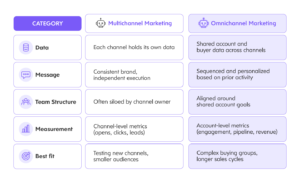
Buyer behavior is a big part of why this distinction matters. Research on B2B buying groups shows 67% of Directors, VPs, and Managers now co-lead purchase decisions, and buyers interact across an average of ten touchpoints before deciding. When five people from one account are each hitting a different channel with no shared context, multichannel marketing alone can’t keep the story straight. Omnichannel can, because it’s built to.
Why Most B2B Omnichannel Strategies Break Down at Scale
Teams don’t fail at omnichannel marketing because they pick the wrong channels. They fail because the channels are owned by different tools, different vendors, or different parts of the org chart, and nobody owns the connection between them.
Here’s the pattern we see most often. Marketing runs ads and email through one platform. Sales runs outbound through a separate sequencing tool. An agency handles paid social. Each group can show you their own numbers, but none of them can tell you what actually happened to a single account across all three. That’s not a data problem you fix with one more integration. It’s what happens when channel interplay across the buying journey is never actually managed as one system.
This is the same root cause behind most broken ABM programs, not just omnichannel ones. When there’s no single team accountable for how the pipeline moves end to end, every handoff between tools and teams is a place where account context gets lost. Adding another channel to a disconnected stack doesn’t create more coverage. It creates more places for the story to break.
How Does an AI-Native ABM Model Close the Omnichannel Execution Gap?
An AI-native ABM model closes the gap by running every channel off one shared account intelligence layer, so agentic AI can sequence outreach, personalize content, and adjust targeting in real time based on what an account just did, instead of waiting for a human to notice and manually update five separate tools.
This isn’t a future-state idea. It’s already changing how ABM programs perform. In the most recent industry benchmark, nearly 80% of B2B organizations now actively run ABM programs, and AI is rated 7.3 out of 10 for improving campaign outcomes, with personalized content cited by 47% of respondents as the single highest-ROI tactic available to them. That’s a meaningful jump from AI as an experiment to AI as core infrastructure, and AI agent adoption in marketing operations is climbing alongside it.
What makes this different from adding an AI tool to your existing stack is where the intelligence sits. On BambooBox’s agentic ABM platform, account signals flow into one system, and AI agents act on those signals across channels automatically, rather than a marketer manually checking five dashboards and updating four tools by hand. The channels don’t multiply. The coordination between them does.
A 5-Step Framework for Building an Omnichannel ABM Strategy
Most omnichannel advice stops at “know your channels.” Building one that actually drives pipeline takes a more specific sequence. Here’s the framework we use with clients:
- Unify your account data first, before adding any channel. Every team touching an account, marketing, sales, and any outside partners, needs to see the same activity history. Without this step, nothing else in the framework works.
- Map channels to buying-committee roles, not funnel stages alone. A finance stakeholder and a technical evaluator on the same account need different channels and different messages at the same point in the journey.
- Sequence touchpoints instead of scattering them. Decide what happens on channel two based on what happened on channel one. A webinar attendee should get a different next email than someone who just visited your pricing page.
- Personalize with AI at the account level, not just the contact level. Personalization that only knows a first name isn’t personalization. It should reflect what the whole buying group has done.
- Measure account-level outcomes, not channel-level vanity metrics. Track pipeline and revenue by account, not opens and clicks by channel. That’s the only view that tells you if the strategy is working.
Teams building this out from scratch often find it faster to start from an existing playbook rather than build the sequencing logic themselves. Our definitive ABM guide walks through the account research and segmentation work that has to happen before step one above will actually hold up.
Omnichannel ABM Platform vs. Agency vs. Managed Model: Which Fits Your Team?
Once a team accepts they need orchestration, not just more channels, they usually face a build-versus-buy decision. Here’s how the three common paths actually compare:
| ABM Platform (self-run) | ABM Agency | Managed AI-Native Model | |
| Who executes day to day | Your internal team | External agency staff | Integrated platform + GTM strategists |
| Account intelligence | You build and maintain it | Agency has limited visibility into your systems | Shared, continuously updated across all channels |
| Handoffs | None, but requires headcount | Frequent, between you and the agency | None, one accountable team |
| Best fit | Teams with strong internal ABM ops capability | Teams that need channel execution but not strategy | Teams that want strategy and execution owned end to end |
A platform alone gives you the technology but leaves the orchestration work on your team. An agency can execute channels well but usually can’t see your systems, which recreates the same handoff problem inside a different set of walls. That’s the gap a managed, AI-native model is built to close: one team, one account intelligence layer, one line of accountability for the pipeline outcome, whether you’re a lean team launching your first ABM motion or an enterprise scaling into new markets.
What Results Can B2B Teams Expect From Omnichannel ABM Execution?
The most meaningful results come from orchestration, not more channels. When we implemented an orchestrated, AI-native ABM motion for a GCC-focused HR client, they crossed 6x their meeting target within 90 days, because every channel was working from the same account signals instead of guessing independently. Other clients running the same model have seen lead-to-opportunity conversion increase by as much as 60%. Results like these don’t come from adding a channel. They come from finally connecting the ones already in place.
Omnichannel marketing isn’t a channel-count problem, and treating it like one is why so many B2B demand generation programs plateau. The teams seeing real pipeline movement have made one shift: every channel now runs off shared account intelligence instead of its own isolated dashboard, and AI is doing the coordination work no human team could do manually at scale.
If your channels are running in parallel but not actually talking to each other, that’s a fixable orchestration problem, not a reason to add another platform to the stack. Book a consultation with BambooBox to map your current channel mix against a single account intelligence layer and see exactly where the gaps are.


